Waasigan · The project
Waasigan Transmission Line
A major 230-kilovolt transmission project in northwestern Ontario — and the flagship that proves the path from training to employment is real.
The project
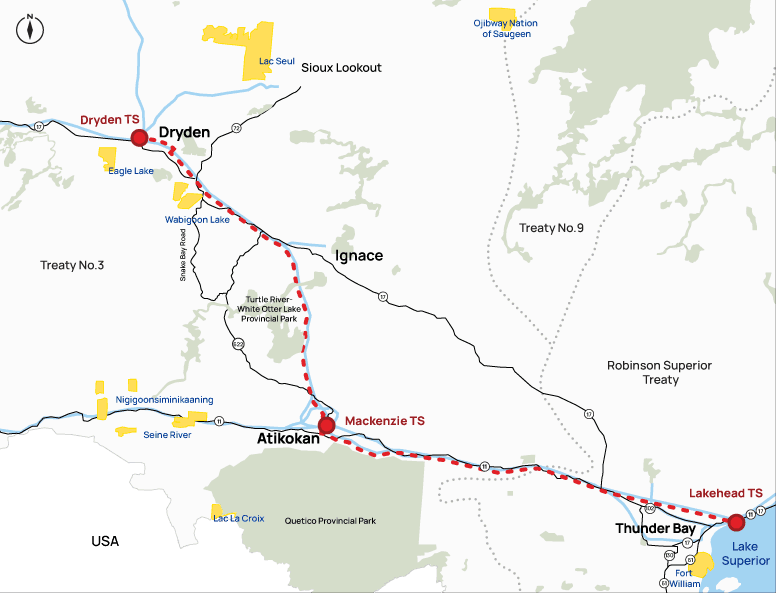
Waasigan delivers two new transmission segments: a double-circuit 230 kV line from Lakehead Transformer Station (TS) in Shuniah to Mackenzie TS in Atikokan, and a single-circuit 230 kV line from Mackenzie TS to Dryden TS.
Together they add roughly 350 megawatts of capacity, which Hydro One expects will help meet growing electricity demand in the region, including from new mining operations.
Phase 1 · Thunder Bay → Atikokan
Hydro One expects it in service later in 2026.
Phase 2 · Atikokan → Dryden
Hydro One expects it in service by the end of 2027.
The partners
- Hydro One Networks Inc. — project owner
- Valard Construction LP — construction & safety, as the engineering, procurement & construction (EPC) contractor
- Chi Mino Ozhitoowin LP — training & opportunity, owned by seven First Nations
Nine partner First Nations are built into the project — through employment, business opportunity, environmental oversight, and agreements to share in ownership of the line.
Throughout, the work respects Anishinaabe traditional values — building participation through training, employment, and Indigenous business development.
By the numbers
The scale of the Waasigan line
- 9
- Partner First Nations
- 350 MW
- New power capacity
- 230 kV
- Transmission voltage
- 2
- Line segments in NW Ontario
Building the line builds opportunity
What the line makes possible
Every kilometre of clearing, every foundation, every tower is a job, a training opportunity, and a step toward something bigger — opportunity that outlasts the project.
From builders to owners
Partner First Nations hold agreements to share in ownership of the line — a step toward economic reconciliation.
How ownership works